

What’s in a Name: Understanding Genus, Species, Varieties, and Cultivars
We’ve all had the experience of receiving a plant catalog or landscaping plan riddled with plant names that can be difficult to comprehend. Navigating the difference between genus, species, varieties, and cultivars is too much to keep straight. Parsing out multiple common names from scientific names? Forget it! In preparation for annual renewals and Spring plantings, let’s break down how plants and trees get their names.
It’s a Redbud! No, it’s a Judas Tree!

Common names are derived from local knowledge, social norms, and regional vernacular. Most plants are not endemic, meaning they grow across different cultures and landscapes. While there is sometimes overlap between the latin name and the common name, for example Pinus vs Pine, more often they have no similarity.
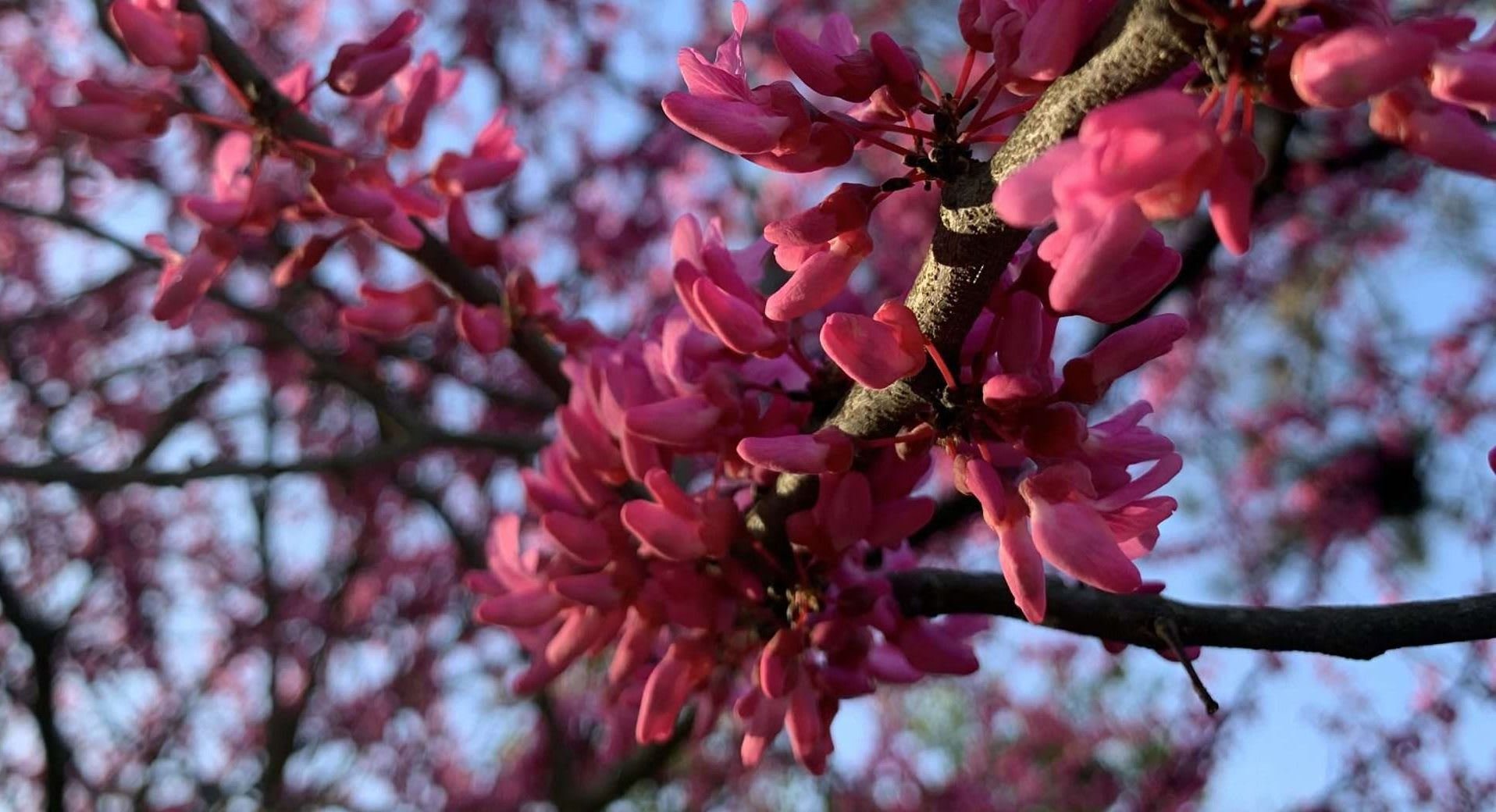
For example, a Redbud is a native tree with multiple common names. Some refer to it as an American Redbud, others an Eastern Redbud. Some people recognize the unique blooms as those of a Judas Tree, which references Christian texts. In mountainous areas, the tree is known as a Spicetree. In contrast, the scientific name is Cercis canadensis, and there is only one.
What is taxonomy, and why do we use it?
Scientists designed the taxonomic system to standardize the naming of plants and trees without ambiguity. The scientific name, also referred to as the latin name, is a unique identifier specific to the genetics and features of the plant. Using the scientific name helps professionals avoid confusion when referring to different plants. In landscape design, arborists would take care to use the scientific name to ensure the expected trees are the ones planted.
In arboriculture, sometimes the specificity of using the scientific name is limited in how useful it can be. For some services, the species does not matter, only the genus. In our field, it can be difficult to identify the precise species without a microscope, and if it doesn’t change our treatment plan, then the time it takes to identify might be more worth spending on inspecting other trees.
Breaking it Down: Genus, Species, Varieties, and Cultivars
Genus vs. Species

The scientific name generally has two parts. The genus is the first word, the second is the specific epithet, and the species is both words together. The genus refers to an array of genetic features that are common across all members, including leaves, flower, bark, fruit or cones. The specific epithet refers to a more specific feature within the genus, perhaps color, bark texture, or environment.
Let’s look at a crabapple; the genus is Malus. The shared characteristic across all species in the Malus genus produce a similar fruit, the apple.
Some common species include:
Malus floribunda, the specific epithet referring to an abundance of flowers.
Malus ‘Prairifire’, the specific epithet referring to the name of the cultivar.
But why is one italicized and the other in quotations?
Varieties vs. Cultivars

A ‘variety’ has naturally developed to be genetically distinct due to geographic conditions. A ‘cultivar’ has been cultivated to be genetically distinct by humans. Often professionals use the terms variety and cultivar interchangeably, but there are technical differences. When written, a cultivar has singular quotations and is not italicized.
For crabapples, there are so many varieties and cultivars, only an expert would know them all. Common varieties include Malus floribunda, Malus baccata, and Malus sargentii. Cultivars that we commonly plant include Malus ‘Sugar Tyme’, Malus ‘Snowdrift’, and Malus sargentii ‘Tina’. The last presents another taxonomic variation, which is a cultivar of the Malus sargentii.
Which name do I use when?
Depending on the context, common names and scientific names might be used interchangeably. For most english speakers, the common names are easier to remember. It’s hard enough to learn to identify a tree or plant, learning the name in another language adds an extra step and isn’t always necessary or useful. That being said, scientific names are the most specific way of referring to a species to ensure you get exactly what you want for your landscape. Understanding the difference between species, varieties, and cultivars gives you the knowledge to form a common ground with the arborists and landscape professionals who care for your trees.

Sources
Penn State Extension: Nomenclature
Woodland (2003) Contemporary Plant Systematics, 3rd ed. Pp. 361-387


We were very pleased with the service and particularly the knowledge & professionalism of your staff. We would certainly recommend you.
We are very pleased with the plantings suggested by and picked out by Mike. The men arrived on time to plant the boxwood and witch hazel tree; dug out the stump and cleaned up. They were pleasant and helpful – we couldn’t have asked for a better team.
We were very pleased and impressed with Dan and his team. We love our new trees and garden.
Thank you so much for all the information you provide – the watering information, the emails and the flier. I read it all and have learned so much. My magnolia trees look surprisingly healthy considering the way they looked when I first called.
Kevin Seger provided expert advice and recommendations about tree maintenance and removal. He listened to my needs and provided a thorough and affordable proposal. On the day of the job, I was very impressed with crew leader, Dave and his team (Felix & Adam). They were professional, efficient, hard-working and very neat about clean-up.
An outstanding job on the four trees and clean-up after the work and removal. We would be happy to recommend your services to everyone – the best tree service we ever have had here in St. Louis.
Kevin was able to come out the same day I called and a crew was out the next day! Great prompt service. I was not at home when the work was done but results show they did a fine job.
Everyone came through as usual when I needed the crew to come back & take out the balance of the fire blight. They did not have a bucket the first time and were so nice and professional about coming back again.
Thank you again for responding to our urgent need after the storm took down our 2 trees & deposited them across our driveway. Your crew, as always, did a fabulous job. Professional, courteous & it is a pleasure doing business with your company.
We appreciate your knowledge and professionalism. Your employees are prompt and courteous and willing to do whatever needs to be done to complete the project. Cleanup was great.
